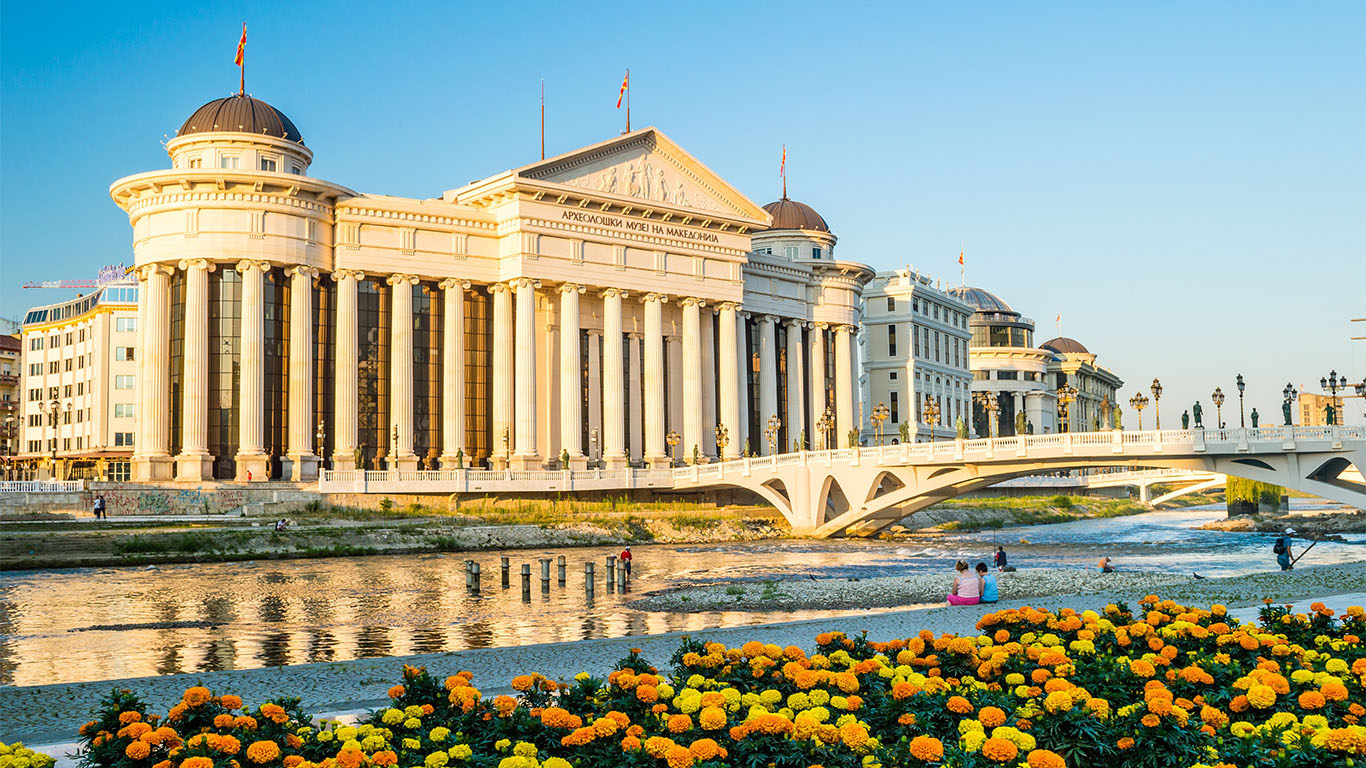
Housed in the grand Old Railway Station building — itself a poignant memorial to the devastating 1963 earthquake — the Museum of Macedonia stands as the nation's premier cultural institution. This comprehensive museum complex tells the story of North Macedonia from prehistoric times through the present day, making it an essential stop for anyone seeking to understand this fascinating Balkan nation.
Museum Overview
The museum is located at the Old Railway Station on Nikola Vapcarov Street in Skopje. Founded in 1924, it has occupied its current location since the 1970s and now holds over 66,000 artifacts across six permanent departments.
The Building's Story
The museum occupies Skopje's former railway station, built in 1938 in modernist style. When the 1963 earthquake struck, the clock stopped at 5:17 AM — still visible on the tower — and the building was severely damaged but partially preserved. Architects repurposed the remaining structure as a museum, so it now serves as both a cultural institution and an earthquake memorial. The frozen clock tower has become an icon of Skopje's resilience.
Permanent Departments
1. Archaeological Museum
Three floors of chronological displays trace human presence in Macedonia from the Neolithic through the Roman period. The prehistoric collection includes figurines from Gabalje and Vrsnik (6000–3000 BC), Bronze Age weapons and tools, and intricate pottery from ancient settlements. The ancient Macedonian section holds gold jewelry from the Trebeništa necropolis, Hellenistic bronze sculptures, Roman-era marble busts and statues, and coins from Alexander the Great's era. Medieval archaeology rounds out the collection with early Christian basilica remains, medieval settlement artifacts, and fortification elements from Tsar Samuel's era. The highlight is the Trebeništa gold mask (replica) — one of the most significant ancient Macedonian finds.
2. Historical Museum
This department covers Macedonian history from the 6th to the 20th centuries. Medieval displays include manuscript replicas, weapons and armor from the Ottoman conquest period, and religious artifacts from Orthodox monasteries. The Ottoman era section presents 16th–19th century documents, traditional crafts and trades, Islamic art and calligraphy, and city development models showing Ottoman Skopje. The National Revival gallery features 19th-century educational materials, documents from the Ilinden Uprising of 1903, and early Macedonian printing press artifacts. The collection closes with Balkan Wars memorabilia and World War I, II, and Yugoslav period artifacts.
3. Ethnological Department
The most popular section in the museum showcases traditional Macedonian life through three interconnected themes. The costume collection holds over 2,000 traditional garments — regional variations from across Macedonia, intricate wedding costumes, and distinctions between festival and everyday wear. The rural life exhibition reconstructs a traditional house interior and displays agricultural tools, livestock equipment, and wine and rakija production tools. Crafts and trades are represented through weaving looms and textiles, woodworking tools, a blacksmith shop recreation, and a pottery workshop. An urban life corner presents 19th-century Skopje home furnishings, a traditional coffee house (kafeana) setup, and merchant shop displays. Visitors can try on replica traditional costumes free of charge.
4. Icon Gallery
The gallery holds over 800 Orthodox icons dating from the 11th to the 19th centuries, including masterpieces from the Ohrid School, pieces from St. Sophia Church (11th century), Mount Athos workshop icons, and works by post-Byzantine Macedonian painters. Notable individual works include "Christ Pantocrator" (14th century) and "Virgin Mary with Child" by an anonymous Ohrid master. Through glass windows, visitors can watch conservators restoring ancient icons in the on-site lab.
5. Natural History Museum
A comprehensive survey of North Macedonia's flora, fauna, and geology. The botanical collection includes a herbarium with 10,000+ plant specimens, rare and endemic Macedonian plants, and a traditional medicinal herbs collection. The zoological section features bear, wolf, lynx, and deer specimens, a bird collection covering 500+ species, and butterfly and insect displays. Geological collections cover minerals from Macedonian mines, fossil specimens, and rock formations. A small aquarium displays endemic species from Lake Ohrid.
6. Contemporary Art Gallery
Rotating exhibitions showcase modern Macedonian artists, with the permanent collection spanning paintings, sculptures, and installations from the 20th and 21st centuries. Featured artists include Nikola Martinoski (pioneer of modern Macedonian art), Lazar Ličenoski, and contemporary young artists.
Visitor Information
Opening Hours and Admission
The museum is open Tuesday through Sunday, 10:00 AM–5:00 PM (last entry 4:30 PM); it is closed on Mondays, January 1, Orthodox Easter, and December 25. Adults pay 200 MKD (€3.25), students and seniors 100 MKD (€1.60), and children under 7 enter free. A photography permit costs 100 MKD (no flash allowed). Admission is free on International Museum Day (May 18), the museum's anniversary (October 12), and the last Sunday of each month.
Guided Tours and Audio Guides
Guided tours are available in Macedonian, English, Albanian, and French. A full-museum tour lasts 90 minutes; single-department tours take 45 minutes. Group tours (up to 10 people) cost 500 MKD (€8) — book by calling +389 2 311 6070 or emailing [email protected] at least 48 hours in advance. Audio guides in English, German, and French are available for 100 MKD rental.
Planning Your Visit
For a quick 1.5-hour visit, prioritize the Ethnological Department (40 min), Icon Gallery (20 min), and archaeological highlights (30 min). A comfortable full visit covering all six departments takes 3–4 hours including a break at the museum café. A full-day in-depth visit works well split as: morning in the Archaeological and Historical museums, lunch at the café, afternoon in the Ethnological and Icon Gallery departments. Bring comfortable shoes (there is a lot of standing and walking), a small water bottle, and a camera with the photography permit. Ground floor is wheelchair accessible with elevator access to some sections; accessible restrooms are available. Parking is limited near the entrance — nearby public lots are a better option.
Special Programs
Educational Workshops
Children's workshops on Saturday mornings (11:00 AM–1:00 PM, 150 MKD per child) cover traditional pottery, weaving, archaeological "dig" simulations, and folk costume dress-up sessions. Adult programs include icon painting workshops, traditional embroidery classes, and archaeology lectures.
Temporary Exhibitions and Events
The museum hosts rotating temporary exhibitions 4–6 times per year — international archaeological finds, contemporary art competitions, traveling exhibitions from European museums, and special themed displays. Check the museum website for current shows. The summer concert series brings classical music and traditional Macedonian folk music to the courtyard every Thursday evening in July and August. A regular lecture series covers archaeological discoveries, art history, and local history seminars.
Research and Library
The museum library is open to researchers by appointment and holds 15,000+ volumes on Macedonian history and culture, plus archives of historical photographs, documents, and maps. Academic ID is required; contact the museum in advance.
Gift Shop
Located near the main entrance, the shop sells museum catalog books, replicas of archaeological finds, traditional craft items, postcards and prints, and children's educational materials. The best buy is the detailed English-language museum guidebook for 400 MKD.
Nearby Attractions
Combine your museum visit with the Memorial House of Mother Teresa (5 min walk), the Macedonian Opera and Ballet (10 min walk), and City Park (5 min walk) for post-museum relaxation. A short drive reaches the Old Bazaar (5 min), Kale Fortress (8 min), and the Millennium Cross (15 min).
The Museum of Macedonia offers an unparalleled overview of North Macedonian culture and history. Visit early in your trip — the context gained here will enhance your appreciation of every other site you visit in North Macedonia.
Distances from Skopje by car
| Destination | Distance | Drive time | Road type |
|---|---|---|---|
| Skopje Airport (SKP) | 21 km | 25 min | A1 motorway |
| Matka Canyon | 17 km | 25 min | Paved single-carriageway |
| Ohrid | 173 km | 2h 30 min | A2 motorway |
| Bitola | 169 km | 2h 15 min | A2 + R-roads |
| Tetovo | 41 km | 35 min | A1 motorway |
| Kosovo border (Blace) | 23 km | 25 min | A1 motorway |
| Pristina | 92 km | 1h 30 min | A1 + R-roads |
Frequently Asked Questions
What are the Museum of Macedonia's opening hours? The museum is generally open Tuesday–Sunday, 09:00–17:00, closed on Mondays and public holidays. Opening hours may vary for special exhibitions — check the museum website or call +389 2 311 6070 before your visit.
How much does entry to the Museum of Macedonia cost? Entrance is approximately 150-200 MKD (≈€2.50-3.50) for adults, with reduced rates for students and seniors. Children under 7 typically free. Prices may change for special exhibitions.
How long does a visit take? Allow 2-3 hours for a thorough visit across all collections. A focused visit to highlights (the prehistoric collection and the Ottoman-era ethnographic exhibits) takes about 1.5 hours.
Is the museum signposted from Skopje city centre? Yes — it is centrally located on the north side of the Vardar River, near the Stone Bridge and the Old Bazaar area. GPS coordinates are readily available. Parking is available on surrounding streets (paid, zone-based) or at the nearby covered car parks.
Can I combine the museum with other Skopje attractions? Easily — the museum is within walking distance of Macedonia Square, the Old Bazaar, the Stone Bridge, and the Memorial House of Mother Teresa. A full cultural day in Skopje can combine all of these without needing to move the car once parked.
Getting There: The museum is centrally located. Rent a car in Skopje for easy access and to explore other nearby attractions. Book online for the published rate.
Related: Skopje city guide with car rental tips | Best day trips from Skopje | Parking in Skopje guide