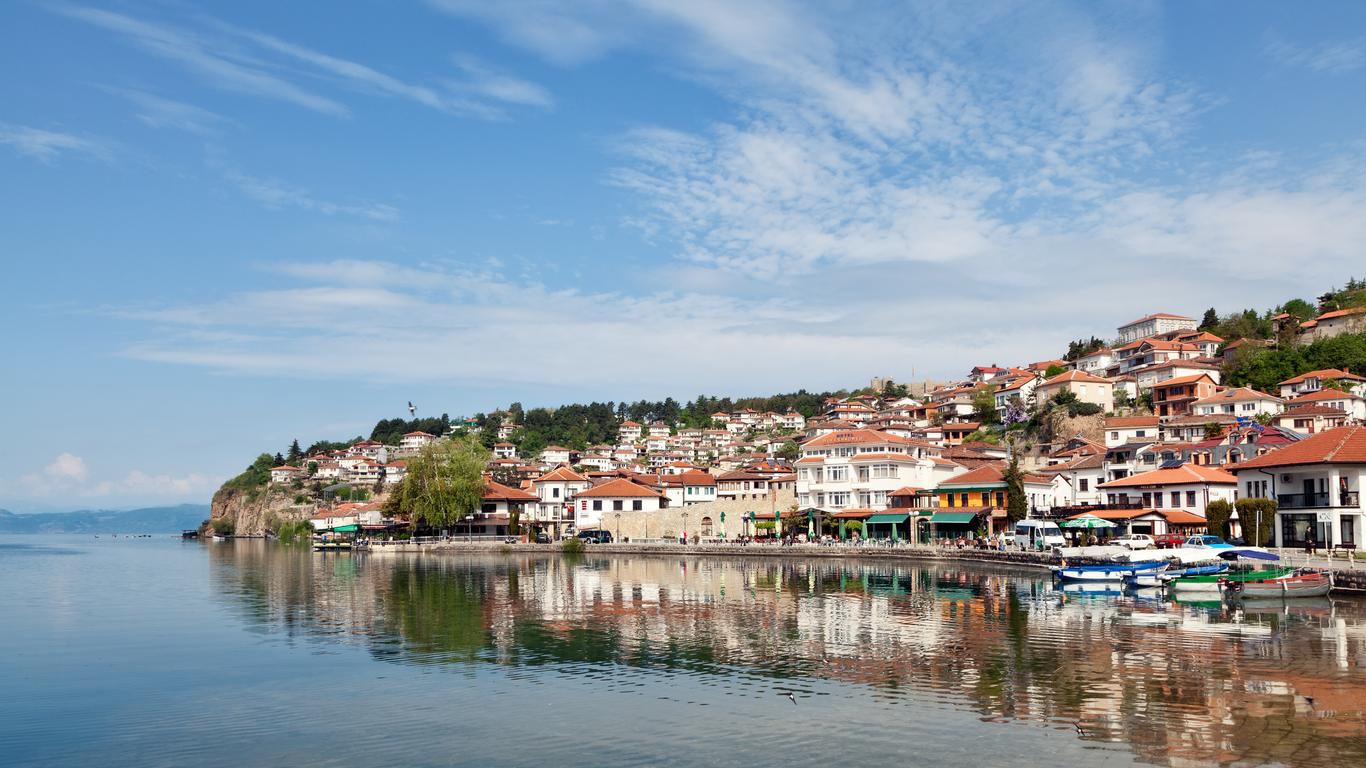
Lake Ohrid is North Macedonia's crown jewel — a UNESCO World Heritage site with water so clear you can see the bottom at 22 meters, medieval churches perched on cliffs above the lake, and a way of life that has continued largely unchanged for centuries. The nearest big international comparison is the Italian lakes, but at a fraction of the cost and with almost none of the crowds. A rental car is the only way to experience it fully.
Here is a three-day itinerary that covers the essential stops without feeling rushed, with practical driving notes for each segment.
Day 1: Skopje to Ohrid — 170 km, approximately 2.5 hours driving
Morning: Prepare and Depart
Fill up with fuel in Skopje before leaving. Petrol is cheap in Macedonia but stations become less frequent once you leave the capital. The A2 motorway heads southwest — follow signs for Tetovo and Gostivar.
Optional stop in Tetovo (40 km from Skopje): The Painted Mosque (Sarena Dzamija) on the banks of the Pena River is worth a 20-minute stop. Dating from the 15th century, it is one of the most colourful Ottoman structures in the Balkans. Park along the riverside road.
Late Morning: The Mountain Section
From Gostivar, the road leaves the flat Polog valley and begins climbing through the Bistra mountain range. This section — roughly 50 km through Kichevo — is the scenic highlight of the drive. The road winds through alpine meadows, spruce forests, and occasional villages that have seen better economic times but retain considerable charm.
Take the Mavrovo fork if time allows: The detour through Mavrovo National Park adds 30 minutes but passes the artificial Mavrovo Lake, the partially submerged church of St. Nicholas visible from the road, and dramatic mountain scenery. This is a preview of what warrants a dedicated visit on another day.
Afternoon: Arrival in Ohrid
The road descends from the mountains and the lake suddenly appears below you — turquoise, enormous, and deeply beautiful. The effect is immediate. Drop your bags at your accommodation (the Old Town and the southern lake shore both have excellent guesthouses) and walk immediately to the Samuel's Fortress before sunset.
Tsar Samuel built his fortress in the 10th century on the hill above the old town. The walls are intact and walkable, and the view across the entire lake basin at golden hour is one of the best in the Balkans. Arrive by 5 pm in summer to secure a good spot.
Evening: Lakeside Dinner
The old town waterfront has dozens of restaurants, ranging from tourist-facing terraces to small family-run places hidden in the lanes above. Ask any guesthouse owner for their recommendation. The local speciality is Ohrid trout (ohridska pastrmka), a species found only in this lake, and the freshwater crayfish (raci). Both are excellent grilled simply with lemon and local white wine.
Day 2: The Lake Circuit — approximately 80 km driving
Allow the full day for this loop. There is no need to rush.
Morning: St. Naum Monastery (29 km south)
Drive south along the lake road from Ohrid town. The road hugs the eastern shore, passing small beaches, fishing villages, and occasional vineyards before arriving at St. Naum Monastery near the Albanian border.
The monastery itself is beautiful — a 9th-century complex with peacocks wandering the grounds, vivid frescoes, and a terrace directly above the lake. But the real attraction is the springs of St. Naum just below the monastery walls. Underground springs feed directly into the lake here, creating pools of impossibly transparent water. Small wooden rowboats take visitors around the springs for a few euros — the visual effect of seeing clearly defined water plants through 5 metres of perfectly clear water is something photographs cannot quite capture.
Allow 90 minutes at St. Naum.
Midday: Bay of Bones and the Eastern Shore
Drive back north along the lake and stop at the Bay of Bones (Zaliv na Kostite). This is a reconstructed Bronze Age settlement built on stilts over the lake, based on actual archaeological evidence from this exact location. The small museum is genuinely interesting and the platform structure over the water is picturesque. Bring swimming gear in summer — the water off the wooden platform is excellent.
Have lunch at one of the restaurants in Gradishte Bay between St. Naum and the Bay of Bones, or continue north to Ohrid for lunch in the old town.
Afternoon: Galicica National Park
This is the highlight of the day. From Ohrid, drive up through the national park on the mountain ridge that separates Lake Ohrid from Lake Prespa. The road climbs steeply — maximum altitude around 1,568 metres — through oak and beech forest before emerging onto open alpine terrain.
At the highest point, pull over at the viewpoint. From here you can see both lakes simultaneously — Lake Ohrid on the west and Lake Prespa on the east. On a clear day, the Albanian mountains frame the western horizon and the Greek border is visible to the south. This is one of the most rewarding viewpoints in the entire Balkan peninsula and it requires a car to reach.
The road descends to Resen on the Prespa side. If you have extra time, drive down to Lake Prespa itself — much less visited than Ohrid, completely different character, fishing villages that feel genuinely remote.
Return to Ohrid via the same Galicica road or loop around through Resen and north on the main road (adds about 40 minutes).
Evening: Church of St. John at Kaneo
Before dinner, walk from the old town along the cliff path to the Church of St. John at Kaneo. This tiny 13th-century church on a rocky promontory above the lake is the most photographed image in all of North Macedonia. At sunset, with the water reflecting the sky and the bell tower silhouetted against the mountains, you will understand why. It is a ten-minute walk from the centre of the old town.
Day 3: Return to Skopje — with optional detour through Bitola
You have two return options depending on your time and interest.
Option A: Direct Return (170 km, ~2.5 hours)
The same A2 highway in reverse. Straightforward, fast, and saves time for a late afternoon Skopje visit. Consider a coffee stop in Kichevo and a final look at the mountains before descending to the flat lowlands around Gostivar.
Option B: Return via Bitola (270 km, ~4 hours)
This adds 90 minutes but passes through some of the most interesting towns in the country:
Struga (15 km north of Ohrid): A small town at the northern end of the lake where the Black Drin river flows out. Famous in the Balkans for its poetry festival. Quick coffee stop and a walk along the river mouth.
Bitola (100 km from Struga): North Macedonia's second city, with a completely different character from Skopje. The main boulevard — Shirok Sokak (Broad Street) — is lined with neoclassical consulate buildings from the Ottoman era, now converted to cafes and restaurants. Spend an hour walking here. The ancient ruins of Heraclea Lyncestis are a 10-minute walk from the boulevard — a 4th-century BC Macedonian city with intact Roman mosaics exposed in the open air, free to enter.
From Bitola, take the E65 north through the Pelagonija plain and Veles gorge back to Skopje.
Practical Notes for the Trip
Vehicle recommendation: Our standard compact cars (Fiat Linea or Peugeot 301 Automatic) are perfect for this trip. The roads are tarmac throughout this itinerary, including Galicica. You do not need an SUV for any part of this route in summer or early autumn. In winter, the Galicica road may be closed — check before driving up.
Fuel: Fill up in Skopje before departure and top up in Ohrid. The Galicica road has no fuel stations.
Tolls: North Macedonia doesn't use a vignette, but the A2 route from Skopje to Ohrid does pass a manned toll gate — pay in cash (MKD or EUR) or by card as you go. Carry a little cash just in case.
Parking in Ohrid: Between June and August, the old town parking lots fill by 10 am on weekends. Staying in the old town and walking to everything avoids this problem completely.
The weekend package: Our weekend rental packages — covering Friday afternoon to Monday morning — are designed exactly for this trip. Economy cars from €78, compact cars from €95, both with unlimited mileage and third-party liability insurance. CDW optional at €7/day.
Route reference
| Segment | Distance | Time | Notes |
|---|---|---|---|
| Skopje to Ohrid | 173 km | 2h 30 min | A2 motorway, fuel at Veles |
| Ohrid to Bitola | 79 km | 1h 30 min | Mountain pass, slow in winter |
| Skopje to Mavrovo | 79 km | 1h 30 min | Mountain road, snow chains Dec-Feb |
| Skopje to Pristina | 92 km | 1h 30 min | Green Card Zone 1 required |
| Skopje to Tirana | 295 km | 4h 30 min | Albania, Green Card Zone 2 |
| Skopje to Sofia | 245 km | 3h 30 min | Bulgaria, A4 motorway |
Frequently Asked Questions
How long does the drive from Skopje to Ohrid take? Approximately 2 to 2.5 hours via the A2 motorway through Tetovo and Gostivar, then the mountain section to Ohrid. Allow extra time on summer Friday evenings (traffic) and winter days (mountain snow). Distance: 170 km.
Is the road to Galičica National Park paved? Yes — the main crossing between Ohrid and Resen (via the Galičica pass) is fully paved tarmac. Driveable in any economy car in summer; can close in heavy winter snow. Drive slowly — the road is narrow in sections.
Do I need to book hotels in advance for Ohrid in summer? Yes. July and August accommodation books out weeks in advance, especially in the Old Town. Book at least 3-4 weeks ahead for peak season.
Can I swim at Lake Ohrid? Yes. Best free beaches: City Beach (near Old Town), Kaneo Beach (accessible by path from Kaneo church), and the municipal beach near Gradište. Water temperature peaks at 24–25°C in late July and August.
Can I cross to Albania from Ohrid? Yes — the Sveti Naum / Tushemisht border crossing is 30 km south. You need the Green Card Zone 1 insurance add-on (€50/rental) arranged in advance with us.
Browse our vehicles for your Ohrid trip or get an instant quote with our online rate included automatically. Our team has been making the Skopje-Ohrid run since 2001 — if you have any questions about the route, contact us and we will answer from experience.
Related: St. Naum Monastery guide | One-way car rental Skopje–Ohrid | Prespa Lake guide | Ohrid old town walking tour | Weekend road trip: Skopje to Ohrid | Heraclea & Bitola guide | Ohrid Airport car rental