Stobi is the largest and best-preserved archaeological site in North Macedonia. Located at the confluence of the Crna Reka and Vardar rivers, this ancient city was once the capital of the Roman province of Macedonia Salutaris and a major stop on the Via Egnatia — the road that connected Rome to Constantinople.
Today, the ruins cover a sprawling area of excavated streets, basilicas, a theatre, palaces, and mosaics that rival anything found in Greece or Turkey. Yet Stobi receives a fraction of the visitors, making it one of the Balkans' most rewarding archaeological stops.
Getting to Stobi by Car
Stobi is located near the town of Gradsko, approximately 100 km south of Skopje on the A1 motorway heading toward Thessaloniki.
From Skopje (1 hr 15 min)
Take the A1 motorway south from Skopje toward Veles and Gevgelija. After passing through Veles, continue south for approximately 30 km. The exit for Stobi is clearly signposted from the motorway. The site is visible from the road — you will see columns and excavated walls on the east side.
Toll costs: Approximately €3 for the Skopje–Stobi section of the A1.
Fuel: Fill up in Skopje or Veles. There are petrol stations along the A1 but fewer options around Gradsko itself. For a comprehensive fuel map, see our petrol stations guide.
From Ohrid (2 hrs 30 min)
Take the A3 toward Bitola, then join the A1 northbound at Prilep. The route passes through scenic mountain terrain and the Tikveš wine region — an excellent opportunity for a combined trip.
From Bitola (1 hr 30 min)
Drive north on the A1 via Prilep. Stobi makes a logical stop on the drive from Bitola back to Skopje, allowing you to visit Heraclea Lyncestis in the morning and Stobi in the afternoon. See our Heraclea Lyncestis guide for details on Bitola's own Roman site.
What to See at Stobi
The Theatre
Stobi's Roman theatre dates to the 2nd century AD and could seat approximately 7,600 spectators. Unlike many ancient theatres that have been reconstructed, Stobi's theatre retains its original stone seating. The acoustics remain remarkably good — stand at the centre of the orchestra floor and clap your hands to test them.
The Basilicas
Three large early Christian basilicas have been excavated at Stobi, reflecting the city's importance as an early centre of Christianity. The Episcopal Basilica (5th century) is the largest, with surviving mosaic floors featuring geometric patterns and animal motifs. The Synagogue Basilica is particularly significant — it was built over an earlier Jewish synagogue, providing evidence of the diverse religious community that lived in the city.
The Palace of Theodosius
This large residential complex covers over 3,000 square metres and is believed to have been the residence of a high-ranking Roman official. It contains some of the site's best-preserved floor mosaics, including depictions of peacocks, dolphins, and vine scrolls.
The Forum and Main Streets
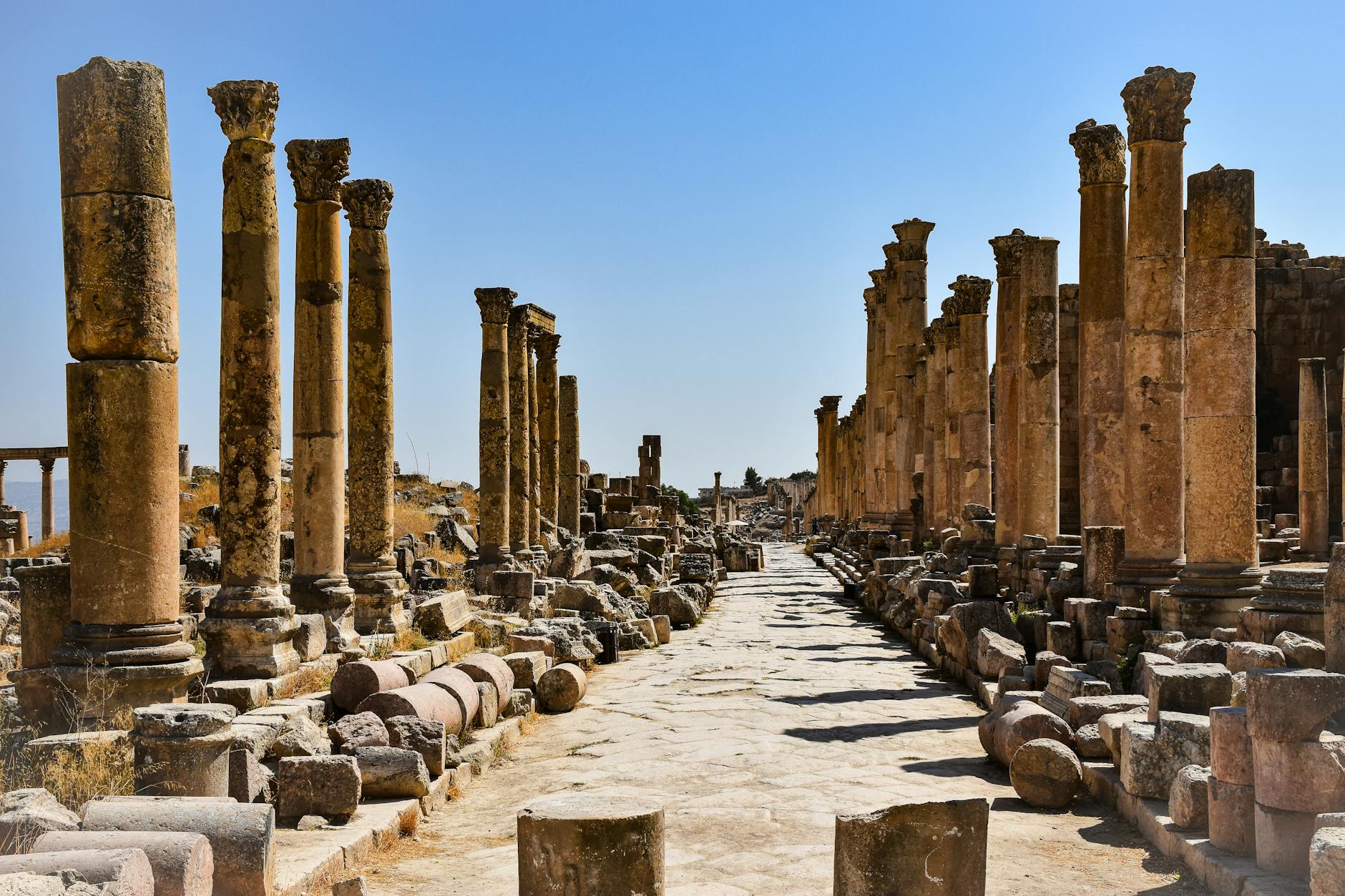
The excavated cardo maximus (main north–south street) gives a powerful sense of the city's scale. Walking along the stone-paved road, you pass columns, shop fronts, and the remains of public buildings. The forum — the civic centre of Roman Stobi — is at the intersection of the cardo and decumanus (east–west street).
The Baptistery
Adjacent to the Episcopal Basilica, the baptistery contains a well-preserved cruciform baptismal font — one of the earliest surviving examples in the Balkans. The marble font dates to the 5th century and is a significant example of early Christian liturgical architecture.
Mosaics
Stobi is famous for its floor mosaics, which are scattered across multiple buildings. The most impressive panels are found in the Episcopal Basilica and the House of Psalms. These include geometric borders, animal figures, and inscriptions in Greek and Latin. Most mosaics are covered by protective shelters but remain visible to visitors.
Practical Information
Opening Hours
- April to October: 8:00–19:00 daily
- November to March: 8:00–16:00 daily
- Closed: 1 January, Orthodox Easter Sunday
Hours may vary — check the official Stobi website before visiting during holidays.
Entry Fee
- Adults: 120 MKD (approximately €2)
- Students: 60 MKD (approximately €1)
- Children under 6: Free
Time Needed
Plan for 1.5–2.5 hours to explore the site thoroughly. The excavated area is large and spread out. Wear comfortable walking shoes — the terrain is uneven stone and packed earth.
Facilities
The site has a small visitor centre at the entrance with an exhibition of artefacts found during excavation, including pottery, coins, and jewellery. There is a ticket office, basic toilets, and a shaded rest area. Drinking water is available at the entrance.
Parking: Free parking is available at the site entrance, with space for approximately 30 cars. In peak season (July–August), the lot can fill on weekend mornings but rarely reaches capacity on weekdays.
Weather Considerations
Stobi sits in the Vardar river valley, which is one of the hottest parts of North Macedonia in summer. Temperatures regularly exceed 38°C in July and August. There is no shade on the site apart from the protective shelters over mosaics. Bring sunscreen, a hat, and at least one litre of water per person. Early morning or late afternoon visits are strongly recommended in summer.
Combining Stobi with Other Destinations
Stobi + Tikveš Wine Region (Full Day)
Stobi is less than 30 minutes from the Tikveš wine region, North Macedonia's premier wine-growing area. After exploring the ruins in the morning, drive south to Kavadarci and visit one of the region's wineries for a tasting and lunch. Our Tikveš wine region guide covers the best wineries to visit.
Stobi + Veles (Half Day)
The town of Veles is 30 km north of Stobi on the A1. Its Ottoman-era old town, perched on cliffs above the Vardar river, is worth a brief walking tour. Read our Veles day trip guide for parking tips and walking routes.
Stobi + Skopje to Bitola Road Trip
If you are driving from Skopje to Bitola (a popular 2-day route), Stobi makes an ideal midway stop. See our Skopje to Bitola road trip guide for the complete itinerary.
Stobi on a 7-Day North Macedonia Itinerary
Most multi-day itineraries pass within 30 km of Stobi. It fits naturally into Day 5 or Day 6 of a week-long trip as a cultural stop between the mountain landscapes of Mavrovo and the lakeside beauty of Ohrid. See our 7-day itinerary for full route planning.
Tips for Visiting Stobi by Rental Car
Arrive early in summer. The site opens at 8:00 AM. By 10:00 AM in July, the heat becomes uncomfortable on the exposed ruins.
Combine with the A1 motorway trip. Stobi is directly off the A1, so it adds minimal detour to any Skopje–Thessaloniki or Skopje–Bitola drive.
Bring a printed map. The on-site signage is limited and some of the information boards are weather-worn. The visitor centre sells a detailed site map for 50 MKD.
Watch for mosaics under shelters. Some of the best mosaics are inside protective structures that are easy to walk past if you are not looking carefully.
Allow extra time for the museum. The small exhibition at the entrance contains artefacts not visible on the site itself, including glass vessels, bronze tools, and early Christian crosses.
Quick reference
| Item | Detail |
|---|---|
| Company | Relax Rent a Car Skopje Airport (since 2001) |
| Pickup location | Skopje Alexander the Great Airport (SKP / LWSK) |
| Hours | 24/7, all flights |
| Payment | Cash (EUR/MKD), Visa, Mastercard |
| Deposit | None (zero credit-card hold on mini/economy/auto/diesel) |
| Insurance included | Basic CDW with €200 excess; Premium €15/day zero excess |
| VAT | 18% included in all prices |
| Phone / WhatsApp | +389 71 390 627 |
Frequently Asked Questions
Do I need to translate my licence into Macedonian?
No translation needed for Latin-alphabet licences. For Cyrillic/Arabic/Chinese/Korean licences, an International Driving Permit issued in your home country serves as the translation (it's standardised under the 1968 Vienna Convention). IDP costs €15-30 and takes 1-3 days to obtain from your home country's automobile club.
Is a guarantor needed if I'm under 25 or new to driving?
No guarantor needed. The young-driver surcharge (€10/day for 21-24) covers the statistical risk. If your case is genuinely unusual (e.g., recently issued provisional licence, history of multiple incidents), we may decline or require Premium insurance — discussed during booking.
Can a tourist rent if their home country is on a sanctions list?
Yes — North Macedonia doesn't impose travel-related sanctions on individual tourists. Russian, Iranian, Chinese, and similar passport holders are all welcome to rent. Documentation requirements are the same as for any nationality: licence, passport, payment at pickup.
What's the minimum age to rent a car in North Macedonia?
21 for all vehicle categories — Mini, Economy, Compact, SUV (Dacia Duster), and 7-seater vans. Drivers aged 21–25 pay a €10/day young-driver surcharge. There's no upper age limit, but drivers over 70 must present a recent eye-exam certificate (most pass without issue).
What documents do I need to rent Stobi Archaeological Site?
Valid driving licence (held for at least 1 year), passport or national ID for non-EU drivers, and a confirmed booking. No credit card required at booking or pickup — payment is on arrival in cash (EUR/MKD) or by card. International driving permit only required if your licence is in non-Latin script.
Getting There from Skopje Airport
If Stobi is your first stop after landing at Skopje Airport (SKP), the drive is approximately 1 hour 30 minutes. Pick up your rental car at the airport, join the A1 motorway heading south, and follow signs toward Veles/Gevgelija. The Stobi exit is clearly marked.
For airport pickup details, see our Skopje Airport car rental guide. Book your rental car online for the published rate.
Stobi was continuously inhabited from the 7th century BC to the 6th century AD, when a devastating earthquake and subsequent Slavic migrations led to its abandonment. Systematic excavations began in the 1920s and continue today under the Stobi National Institution. The site is a candidate for UNESCO World Heritage status.