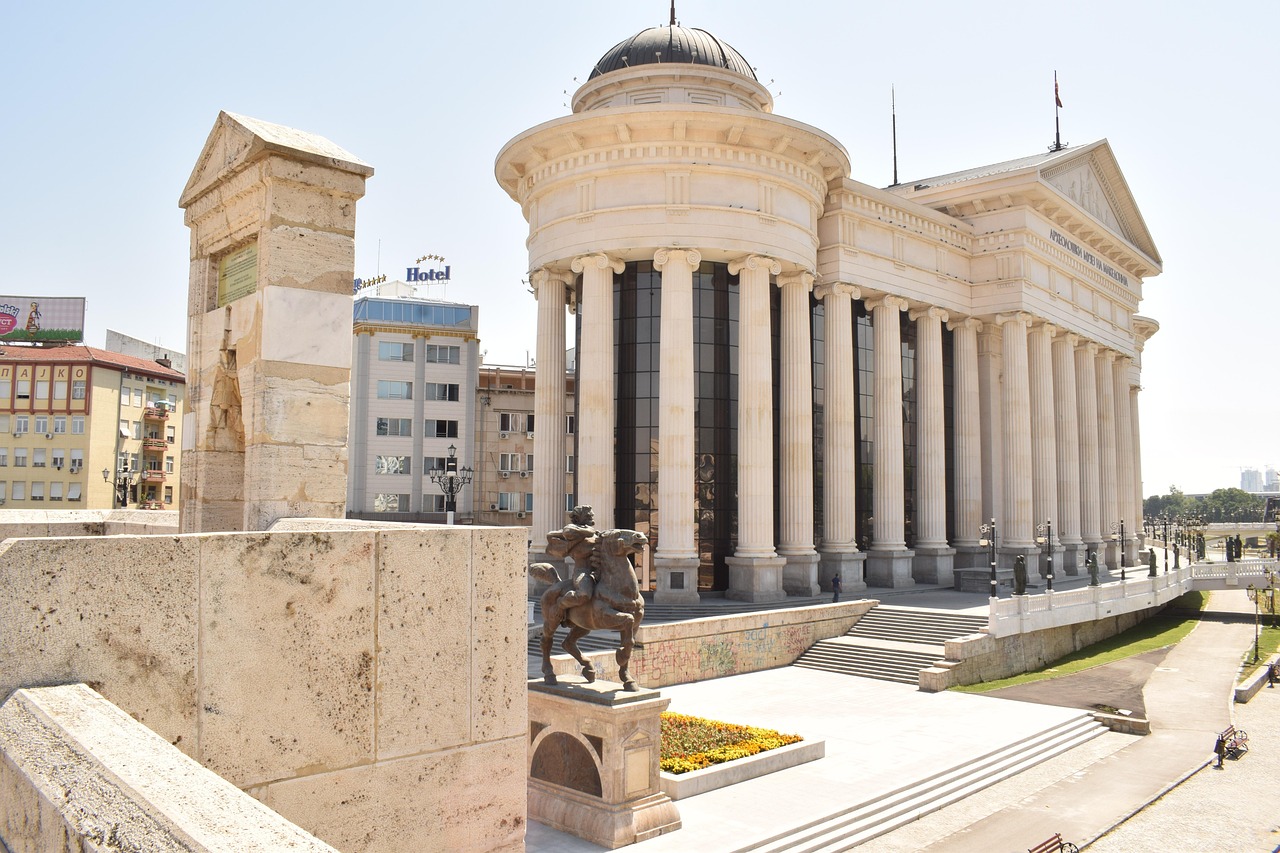
The "Skopje 2014" project remade the centre of North Macedonia's capital between 2010 and 2018. Driven by a government wanting to redress what it saw as the city's lack of historical monumentality after the 1963 earthquake, the project added more than 40 new buildings and around 130 statues, fountains, and bridges in a self-consciously neoclassical idiom. It is among the most controversial urban-renewal projects in modern European history — some Macedonians love it, others consider it a costly affectation, and architects abroad mostly raised their eyebrows.
Whatever your opinion, it makes for one of the most photographable city walks in the southern Balkans. This guide covers the major buildings, the statues, and the context.
The Background — Skopje 2014 Architecture Tour
Before 2010, central Skopje was largely the work of Kenzo Tange, the Japanese modernist architect commissioned to re-plan the city after the 1963 earthquake. The result was a low-rise, brutalist-modernist civic centre with abundant public space and a careful relationship to the Vardar river. Many international architects regarded it as a successful piece of post-disaster urbanism.
Skopje 2014 was the political answer to a different question: how to give the country, which had only existed under that name since 2019 (and as the Republic of Macedonia from 1991), a sense of monumental historical continuity. The project covered three core sites — Macedonia Square, the river embankment, and the access ring around the new museums — with new buildings in what critics call "Disney neoclassicism."
The total cost is disputed — government figures gave €207 million, opposition estimates ranged up to €670 million.
Macedonia Square
The central square of Skopje, redesigned with a marble pavement and ringed by statues. Walk into the square from the south end of the Stone Bridge and you face the project's centrepiece.
Warrior on Horseback (Alexander the Great)
The 22-metre bronze statue of a warrior on horseback dominates the square. Officially titled "Warrior on Horseback" — the government carefully avoided the name Alexander the Great in formal documents — but every Macedonian and visitor recognises the figure. Underneath, a fountain that lights up at night and pulses with classical music every hour.
The statue triggered a long diplomatic argument with Greece over the use of Hellenic-era symbolism, ultimately resolved by the 2018 Prespa Agreement that renamed the country.
Surrounding Statues
The square is ringed by statues of Phillip II of Macedon (Alexander's father), Macedonian medieval rulers, modernist intellectuals, and freedom fighters. The naming and selection of figures was politically charged — many statues were added or modified during construction.
Triumphal Arch (Porta Macedonia)
A 21-metre marble triumphal arch directly off the square, decorated with bronze panels depicting Macedonian historical scenes. It cost roughly €4.5 million and serves no traffic function — it's purely a monument.
The River Embankment Statues
Walk east along the Vardar from the Stone Bridge. Two new pedestrian bridges — Eye of London and Art Bridge — flank the existing Stone Bridge and are lined with bronze statues of historical Macedonians: poets, musicians, scientists, freedom fighters. There are over 30 figures across the two bridges. The selection is comprehensive but, again, politically curated — certain national figures present, others conspicuously absent.
The embankment cafés on the south bank give the best vantage point on the bridges.
The New Museums
The Skopje 2014 project added or wrapped four major museum buildings in neoclassical façades:
Archaeological Museum of Macedonia
The most prominent of the new buildings — a long marble façade running along the south bank of the Vardar with classical columns and a domed roof. Inside is genuinely worth visiting: artifacts from Stobi, Heraclea, Lychnidos (Ohrid), and the Vardar valley sites. €4 entry.
For the full collection, see the Museum of Macedonia Skopje guide and the North Macedonia museums guide.
Museum of the Macedonian Struggle
Wrapped in a similar neoclassical exterior on the south bank. Covers the late 19th- and early 20th-century Macedonian liberation movement. The interior is largely waxwork dioramas — divisive in approach, but the building itself is a Skopje 2014 set-piece.
Holocaust Memorial Centre for the Jews of Macedonia
Smaller, more sombre, and less stylistically aggressive than the main 2014 buildings. Free entry; the exhibits are excellent.
Museum of Contemporary Art
Pre-existing modernist building (Tange-era), not part of Skopje 2014, but visually opposite to the project. Worth visiting for contrast.
The New Government Buildings
The Constitutional Court, the Ministry of Foreign Affairs, and the State Archive all received Skopje 2014 façades — replacing modernist exteriors with neoclassical fronts. Stand on the south bank and look across at the row of marble columns.
The buildings are not open to the public, but the exteriors are the most coherent stretch of the project's architectural vision.
What Locals Think
Polling on Skopje 2014 has been split throughout the project's life. Younger urban Macedonians, architects, and the political opposition have generally been critical — citing the cost, the questionable historical framing, and the disregard for the Tange-era modernist heritage. Older voters and tourists have been more positive, citing the new public spaces and the visual coherence of the central area.
Internationally, The Guardian's architecture critic called it "one of the most absurd urban makeovers in living memory" — but Instagram photographers love it.
The fairest description: it's a real, large, visually distinctive piece of work, and Skopje is the only city in Europe where you can see something like it. Walk it and form your own opinion.
A Walking Route
A 90-minute walk covers the highlights:
- Start at the Stone Bridge north end (Old Bazaar side)
- Cross to Macedonia Square — the Warrior on Horseback fountain
- Triumphal Arch (Porta Macedonia)
- Walk east along the south bank
- Archaeological Museum exterior
- Eye of London Bridge statues
- Art Bridge statues
- Holocaust Memorial Centre (free entry, 30 min interior)
- Return to Macedonia Square
- Coffee at one of the south-bank cafés overlooking the river
Combine with the Stone Bridge & Vardar river walk for a half-day exploration of central Skopje.
Skopje 2014 is genuinely photogenic — perhaps its most successful aspect.
- Sunset lights up the marble façades and the Warrior on Horseback statue
- Night brings the colour-changing fountain and illuminated statues into play
- Reflection shots off the Vardar river work especially well at dawn
Skopje is one of the most under-photographed European capitals. Bring a camera.
Distances from Skopje by car
| Destination | Distance | Drive time | Road type |
|---|---|---|---|
| Skopje Airport (SKP) | 21 km | 25 min | A1 motorway |
| Matka Canyon | 17 km | 25 min | Paved single-carriageway |
| Ohrid | 173 km | 2h 30 min | A2 motorway |
| Bitola | 169 km | 2h 15 min | A2 + R-roads |
| Tetovo | 41 km | 35 min | A1 motorway |
| Kosovo border (Blace) | 23 km | 25 min | A1 motorway |
| Pristina | 92 km | 1h 30 min | A1 + R-roads |
Frequently Asked Questions
What is the Skopje 2014 project? Skopje 2014 was an urban-renewal project (2010–2018) that added more than 40 neoclassical buildings and around 130 statues, fountains, and bridges to the centre of Skopje. The project was politically controversial, expensive (€207–670 million depending on whose estimate), and stylistically divisive — but it has reshaped central Skopje and made it visually distinctive in Europe.
Is the Warrior on Horseback statue actually Alexander the Great? Officially the statue is titled "Warrior on Horseback" — the government avoided naming Alexander explicitly to limit a diplomatic dispute with Greece. Practically, every Macedonian and visitor identifies the figure as Alexander the Great. The 2018 Prespa Agreement with Greece resolved the broader naming dispute.
How long does it take to walk Skopje 2014? Allow 90 minutes to 2 hours for the major buildings and statues, depending on whether you visit the museum interiors. The walk is flat, central, and easily combined with the Old Bazaar on the north bank.
Is Skopje 2014 worth seeing? Yes — it's a unique piece of urban history, regardless of your opinion of the architecture. Few European cities have undergone such a dramatic visual transformation in the 21st century. The fountains, statues, and night lighting are genuinely photogenic.
What do locals think of Skopje 2014? Opinion is split. Younger urban residents and architects have generally been critical — citing the cost and the displacement of the Tange-era modernist character. Older voters and tourists have been more positive about the new public spaces. The project remains a live political topic in North Macedonia. Relax Rent a Car Skopje Airport has operated since 2001 from Alexander the Great Airport (SKP), serving travellers across North Macedonia and the Western Balkans.